People start religions all the time – some even manage it accidentally. During the Second World War, the natives of the Melanesian island of Tanna encountered black Westerners for the first time, and, more importantly, saw them enjoying large quantities of airlifted goods. Their only previous Western contact had been with white missionaries and planters and they came to believe, somewhat paradoxically, that if they rejected the white way of life, returning instead to their traditional ways, they too would be granted access to all the miraculous wealth of the West. To this day, the cultists believe that a god called John Frum (Possibly a pidgin abbreviation of “John From America”) will one day come to make them rich. His personality appears to be a combination of the local deity Kerapenmun and recent import John The Baptist. If you think that’s odd, Tanna is also home to a cult of Prince Philip worshippers.
In the UK, however, religions don’t really have any special status outside of very specific legal contexts (employment discrimination law and religiously-motiviated violence), so there’s little advantage in seeking official sanction. The government doesn’t particularly care what you believe.
390,000 Britons did indeed enter their religion as “Jedi” on the 2001 Census, believing they were mischievously forcing the government to acknowledge The Force as an official religion. But in the tradition of young Padawans since a Long Time Ago, they were reckless. All the Office Of National Statistics was forced to acknowledge was that 0.7 per cent of the British population got a kick out of writing “Jedi” on an offical piece of paper.
25 of the Jedi adherents were from the tiny Isles of Scilly, 28 miles off the coast of Cornwall – go, Scilly!
Tuesday, 9 September 2008

Wednesday, 3 September 2008
WRONG: Columbus discovered America
On October 12 1492, having spent two months on board a rancid, crowded ship crossing the Atlantic Ocean with no guarantee of a destination, the Genoese adventurer Christopher Columbus finally made landfall in America. But he wasn’t the first to arrive on the continent. He wasn’t even the first European to arrive on the continent. He didn’t, strictly speaking, arrive on the continent at all – he was on an island that the locals called Guanahani, and which he renamed San Salvador. (It’s now one of the Bahamas, though no one’s sure which one.)
Columbus didn’t actually find mainland America until August 1498, six years later, on his third voyage. He made landfall in Venezuela, describing the natives as being “very numerous, and for the most part handsome in person”. He never made it to North America, and he died convinced that he’d landed in India.
It’s often claimed that Columbus undertook his voyages to prove the earth was round. In fact, there wasn’t a lot of dissent on that subject among the learned, and Columbus actually came to believe that it wasn’t a sphere. “I have come to another conclusion regarding the earth,” he wrote to the King of Spain. “Namely, that it is not round as they describe, but of the form of a pear… or like a round ball, upon one part of which is a prominence like a woman’s nipple.” Sailors, eh?
While Columbus may have started the rush to exploit the New World, other explorers have a greater claim to the title The First European In America (the hunter-gatherers who crossed the Bering land-bridge and colonised America 25,000 years earlier, were, of course, Asian). John Cabot, or Giovanni Caboto to give him his proper name, was the first to map the North American coastline in 1497, placing him on the mainland a year earlier than Columbus.
Before the arrival of either of the notable explorers, however, the Vikings had settled Greenland and Newfoundland. In 1960 archeologists discovered the 1,000-year-old remains of a Norse village in L’Anse Aux Meadows in Newfoundland. Among the debris found on site were a bronze fastening-pin and a bone knitting needle, which makes you wonder a little about the Vikings’ reputation as hammer-swinging berserkers. (The Vikings didn’t have horned helmets either, by the way, that’s a myth.)
Norse sagas also recall Leif Ericsson’s arrival in Vinland (usually identified as Newfoundland) to preach the Catholic faith. They mention lands called Markland (“wood land”) and Helluland (“stone land”) to its south.
Evidence is much sketchier for the claims made for other nations’ expeditions. Among those chancing their arms:
• Ireland – St Brendan was reported as having made a legendary journey to the “Isle Of The Blessed” in the sixth century CE.
• Polynesia – a cross-disciplinary team of anthropologists and biologists claims that their DNA studies of ancient chicken remains prove that the birds, which are native to South-East Asia, must have been introduced to South America by Polynesians no later than 1424. Their thesis is backed up by the discovery of sweet potatoes, an American vegetable, in archeological digs of pre-European Polynesian settlements.
• Australia – Similarities in skull types between Australian aborigines and prehistoric Brazilians have led some to speculate that aborigines somehow found their way to Brazil around 50,000 years ago, 25,000 years before the arrival of bands of settlers across the Bering land bridge from Asia.
• Mali – Drawing from a tradition of oral history and ancient Egyptian documents, the historian Gaoussou Diawara theorised that the Muslim emperor Abubakari II sailed to Brazil in 1312 with a fleet of 2000 small boats.
• China – Gavin Menzies, a retired British submarine commander, wrote a popular book claiming Admiral Zheng He made it to America in 1421 (he must have been practically neck-and-neck with the Polynesians if he did).
• Portugal – There is evidence to suggest skeletons found in Canada may be Portuguese, dating from 1424.
Columbus didn’t actually find mainland America until August 1498, six years later, on his third voyage. He made landfall in Venezuela, describing the natives as being “very numerous, and for the most part handsome in person”. He never made it to North America, and he died convinced that he’d landed in India.
It’s often claimed that Columbus undertook his voyages to prove the earth was round. In fact, there wasn’t a lot of dissent on that subject among the learned, and Columbus actually came to believe that it wasn’t a sphere. “I have come to another conclusion regarding the earth,” he wrote to the King of Spain. “Namely, that it is not round as they describe, but of the form of a pear… or like a round ball, upon one part of which is a prominence like a woman’s nipple.” Sailors, eh?
While Columbus may have started the rush to exploit the New World, other explorers have a greater claim to the title The First European In America (the hunter-gatherers who crossed the Bering land-bridge and colonised America 25,000 years earlier, were, of course, Asian). John Cabot, or Giovanni Caboto to give him his proper name, was the first to map the North American coastline in 1497, placing him on the mainland a year earlier than Columbus.
Before the arrival of either of the notable explorers, however, the Vikings had settled Greenland and Newfoundland. In 1960 archeologists discovered the 1,000-year-old remains of a Norse village in L’Anse Aux Meadows in Newfoundland. Among the debris found on site were a bronze fastening-pin and a bone knitting needle, which makes you wonder a little about the Vikings’ reputation as hammer-swinging berserkers. (The Vikings didn’t have horned helmets either, by the way, that’s a myth.)
Norse sagas also recall Leif Ericsson’s arrival in Vinland (usually identified as Newfoundland) to preach the Catholic faith. They mention lands called Markland (“wood land”) and Helluland (“stone land”) to its south.
Evidence is much sketchier for the claims made for other nations’ expeditions. Among those chancing their arms:
• Ireland – St Brendan was reported as having made a legendary journey to the “Isle Of The Blessed” in the sixth century CE.
• Polynesia – a cross-disciplinary team of anthropologists and biologists claims that their DNA studies of ancient chicken remains prove that the birds, which are native to South-East Asia, must have been introduced to South America by Polynesians no later than 1424. Their thesis is backed up by the discovery of sweet potatoes, an American vegetable, in archeological digs of pre-European Polynesian settlements.
• Australia – Similarities in skull types between Australian aborigines and prehistoric Brazilians have led some to speculate that aborigines somehow found their way to Brazil around 50,000 years ago, 25,000 years before the arrival of bands of settlers across the Bering land bridge from Asia.
• Mali – Drawing from a tradition of oral history and ancient Egyptian documents, the historian Gaoussou Diawara theorised that the Muslim emperor Abubakari II sailed to Brazil in 1312 with a fleet of 2000 small boats.
• China – Gavin Menzies, a retired British submarine commander, wrote a popular book claiming Admiral Zheng He made it to America in 1421 (he must have been practically neck-and-neck with the Polynesians if he did).
• Portugal – There is evidence to suggest skeletons found in Canada may be Portuguese, dating from 1424.
Tuesday, 26 August 2008
WRONG: Jesus definitely existed
Next time you’re in Japan, make a journey to the village of Shingo at the far north of Honshu island. You’ll find a road sign marked "Christ Grave", leading to a tomb with a cross on it. Local legend has it that rather than die on the cross, Jesus fled through Russia to Japan and lived out his days in Shingo as a rice farmer with his wife Miyuko and his three daughters.
(The dead guy on the cross was apparently Jesus’ brother Isukiri, who sneaked up there when the Romans weren’t looking so that Jesus could escape.)
The Bible disagrees. As far as Christians are concerned, Jesus lived and died in Palestine roughly between 1 and 38 CE. (CE, the secular equivalent of AD, stands for Common Era. The dating of Jesus’ birth by those who accept he existed is pretty vague in its own right. Estimates by historians place it between 18BC and 1AD.)
The trouble is, there’s no proof outside of the Bible itself. The New Testament (the part of the Bible written after Christ) is an assemblage of books written at different times by different authors, and the authenticity of the ones claiming to be eyewitness testimony is suspect. Parts of the Gospels of Luke and Matthew, for example, contradict each other, while other parts appear to be copied from the Gospel of Mark. Mark, meanwhile, is suspiciously confused about Palestinian geography for a native.
Mark, incidentally, also mentions Jesus having sisters. Look it up – chapter six, verse three.
The earliest non-Biblical reference to Jesus was by Flavius Josephus, a Jewish historian born in 37CE. In his Antiquities Of The Jews, written about 93CE, he – improbably for an ultra-orthodox Pharisee – describes Jesus as being “the Christ”, or Messiah. Even The Catholic Encyclopedia acknowledges that, “The passage seems to suffer from repeated interpolations,” meaning it is very likely that the key sentences are a forgery, inserted into the text by 4th-century Christian translators.
Writing in 112CE, the Roman historian Tacitus described in his Annals Nero’s persecution of Christians 50 years earlier and mentioned their founder “Christus”. Errors in his description of Pilate imply, however, that his sources were Christians in Rome rather than offical documents. The passage itself is open to question – the radical former clergyman Robert Taylor claimed that there was no evidence for it even existing in copies of the Annals before the 15th century. More pesky forgers.
Suetonius, author of The Twelve Caesars (120CE) referred to “disturbances at the instigation of Chrestus” among Jews in Rome, though Chrestus was a common Greek name and may simply have been a local troublemaker. Aside from these three, the dozens of Greek, Roman and Jewish historians writing at the supposed time of Christ or in the century after made no reference to him whatsoever.
As Bertrand Russell wrote, “Historically, it is quite doubtful whether Christ ever existed at all, and if he did we do not know anything about him.” Even the things we think we know are dubious. Belgian historian Franz Cumont, for example, uncovered the following details about Mithras, already an enormously popular deity among Romans and other gentiles by Jesus’ time. Mithras was worshipped as “The light of the world”, he was part of a holy trinity in a cosmology that invoked heaven and hell, and he would redeem his worshippers on the Day of Judgement. His birthday festival was on 25 December, and he took part in a last supper before he died and ascended to heaven. His worshippers underwent baptism, ritually consumed bread and wine on Sundays and celebrated a rite of rebirth in late March/early April[3][4]. Quite a coincidence.
(The dead guy on the cross was apparently Jesus’ brother Isukiri, who sneaked up there when the Romans weren’t looking so that Jesus could escape.)
The Bible disagrees. As far as Christians are concerned, Jesus lived and died in Palestine roughly between 1 and 38 CE. (CE, the secular equivalent of AD, stands for Common Era. The dating of Jesus’ birth by those who accept he existed is pretty vague in its own right. Estimates by historians place it between 18BC and 1AD.)
The trouble is, there’s no proof outside of the Bible itself. The New Testament (the part of the Bible written after Christ) is an assemblage of books written at different times by different authors, and the authenticity of the ones claiming to be eyewitness testimony is suspect. Parts of the Gospels of Luke and Matthew, for example, contradict each other, while other parts appear to be copied from the Gospel of Mark. Mark, meanwhile, is suspiciously confused about Palestinian geography for a native.
Mark, incidentally, also mentions Jesus having sisters. Look it up – chapter six, verse three.
The earliest non-Biblical reference to Jesus was by Flavius Josephus, a Jewish historian born in 37CE. In his Antiquities Of The Jews, written about 93CE, he – improbably for an ultra-orthodox Pharisee – describes Jesus as being “the Christ”, or Messiah. Even The Catholic Encyclopedia acknowledges that, “The passage seems to suffer from repeated interpolations,” meaning it is very likely that the key sentences are a forgery, inserted into the text by 4th-century Christian translators.
Writing in 112CE, the Roman historian Tacitus described in his Annals Nero’s persecution of Christians 50 years earlier and mentioned their founder “Christus”. Errors in his description of Pilate imply, however, that his sources were Christians in Rome rather than offical documents. The passage itself is open to question – the radical former clergyman Robert Taylor claimed that there was no evidence for it even existing in copies of the Annals before the 15th century. More pesky forgers.
Suetonius, author of The Twelve Caesars (120CE) referred to “disturbances at the instigation of Chrestus” among Jews in Rome, though Chrestus was a common Greek name and may simply have been a local troublemaker. Aside from these three, the dozens of Greek, Roman and Jewish historians writing at the supposed time of Christ or in the century after made no reference to him whatsoever.
As Bertrand Russell wrote, “Historically, it is quite doubtful whether Christ ever existed at all, and if he did we do not know anything about him.” Even the things we think we know are dubious. Belgian historian Franz Cumont, for example, uncovered the following details about Mithras, already an enormously popular deity among Romans and other gentiles by Jesus’ time. Mithras was worshipped as “The light of the world”, he was part of a holy trinity in a cosmology that invoked heaven and hell, and he would redeem his worshippers on the Day of Judgement. His birthday festival was on 25 December, and he took part in a last supper before he died and ascended to heaven. His worshippers underwent baptism, ritually consumed bread and wine on Sundays and celebrated a rite of rebirth in late March/early April[3][4]. Quite a coincidence.
Tuesday, 19 August 2008
WRONG: You can still be executed in Britain for High Treason, Piracy and Arson in Her Majesty’s Shipyards
For some reason, this old saw is still lingering wherever pedants meet pubs.
A ridiculous number of offences have been punishable by death in Britain over the years. So many, in fact, that the statute books of the 18th century later became known as “The Bloody Code”. Alongside murder, you could be executed for treason, stealing from a shipwreck or from a rabbit warren, writing graffiti on Westminster Bridge, poaching, stealing letters, sacrilege, blacking-up your face at night (this was more a measure against robbery than minstrels), impersonating a Chelsea Pensioner (again, a measure against benefit frauds, rather than impressionists), cutting down young trees, being in the company of gypsies for a month and, remarkably, “strong evidence of malice” in 7-to-14-year-old children. According to the Lord Chief Justice, in 1801 a boy of 13 was executed for stealing a spoon.
Executions were popular public events. In 1807, 40,000 came to see the hanging of the murderers Owen Haggerty and John Holloway at the Old Bailey – so many that a sudden rush near a pie stall caused more than thirty spectators to be trampled to death. Given the circumstances, the irony may have been lost on them.
By 1861, various parliamentary reformers had managed to reduce the list of capital crimes to four: murder, high treason, arson in royal dockyards and piracy with violence. A century later, the Murder Act (Abolition Of The Death Penalty) of 1965 introduced a five-year moratorium on execution for murder that was made permanent in 1969. Outstanding death sentences were commuted, but it was too late for Gwynne Owen Evans (also known as John Welby) and Peter Allen, a pair of small-time thieves who stabbed a workmate of Evans’ to death during a robbery. They were simultaneously hanged in Manchester and Liverpool respectively, becoming the last people to be executed in Britain.
High treason ceased to be a capital crime in 1971 and the Crime And Disorder Act of 1998 put an end to the remaining two. In 1999, Jack Straw signed the 6th protocol of the European Convention On Human Rights, formally abolishing the death penalty, though the Convention does contain the proviso that any signatory state may employ it during time of war. In 2002, the penalty was abolished in the Turks and Caicos islands in the West Indies (see here for more about British overseas territories), meaning that it is now impossible to be executed for any crime on British territory anywhere in the world, no matter whose rabbit warren you’ve been caught with your hand in.
A ridiculous number of offences have been punishable by death in Britain over the years. So many, in fact, that the statute books of the 18th century later became known as “The Bloody Code”. Alongside murder, you could be executed for treason, stealing from a shipwreck or from a rabbit warren, writing graffiti on Westminster Bridge, poaching, stealing letters, sacrilege, blacking-up your face at night (this was more a measure against robbery than minstrels), impersonating a Chelsea Pensioner (again, a measure against benefit frauds, rather than impressionists), cutting down young trees, being in the company of gypsies for a month and, remarkably, “strong evidence of malice” in 7-to-14-year-old children. According to the Lord Chief Justice, in 1801 a boy of 13 was executed for stealing a spoon.
Executions were popular public events. In 1807, 40,000 came to see the hanging of the murderers Owen Haggerty and John Holloway at the Old Bailey – so many that a sudden rush near a pie stall caused more than thirty spectators to be trampled to death. Given the circumstances, the irony may have been lost on them.
By 1861, various parliamentary reformers had managed to reduce the list of capital crimes to four: murder, high treason, arson in royal dockyards and piracy with violence. A century later, the Murder Act (Abolition Of The Death Penalty) of 1965 introduced a five-year moratorium on execution for murder that was made permanent in 1969. Outstanding death sentences were commuted, but it was too late for Gwynne Owen Evans (also known as John Welby) and Peter Allen, a pair of small-time thieves who stabbed a workmate of Evans’ to death during a robbery. They were simultaneously hanged in Manchester and Liverpool respectively, becoming the last people to be executed in Britain.
High treason ceased to be a capital crime in 1971 and the Crime And Disorder Act of 1998 put an end to the remaining two. In 1999, Jack Straw signed the 6th protocol of the European Convention On Human Rights, formally abolishing the death penalty, though the Convention does contain the proviso that any signatory state may employ it during time of war. In 2002, the penalty was abolished in the Turks and Caicos islands in the West Indies (see here for more about British overseas territories), meaning that it is now impossible to be executed for any crime on British territory anywhere in the world, no matter whose rabbit warren you’ve been caught with your hand in.
Tuesday, 12 August 2008
WRONG: Inflation is a bad thing
Inflation, or the ongoing rise in prices that reduces the spending power of money, is the bane of every national treasury. For the uninitiated, it’s the mysterious tendency of the pound (or cruzeiro, or baht) in your pocket to buy you less and less each year. It’s measured against the Consumer Price Index, which tracks the cost of a literal (and big, and unlikely) shopping basket of goods. The basket for 2007 included:
•olive oil
•broccoli
•frozen pizza
•an electric fan
•a toothbrush
•chicken kievs
•a digital radio
•tracksuit bottoms
•wallpaper paste
•kiwi fruit
•nursing home fees
•motor oil
•a dvd recorder
•an acoustic guitar
•compost
•a hamster
•squash court hire
•fish and chips
•“corn-based snacks”
The following is one very simple model of inflation (the “cost push” model, if you really want to know):
1. Everyone wants higher wages.
2. As wages go up, employers pass on the cost of the raises to consumers by putting up prices.
3. If prices are up, everyone wants higher wages.
4. Go to Stage 2.
Monetarists, who are generally followers of the economist Milton Friedman, would say inflation is the result of changes to the money supply. The more money there is in circulation, the less it is worth, as the German government of the 1920s discovered when they printed so many banknotes that people found it cheaper to burn them than buy firewood. In Hungary in July 1946, prices more than tripled every day, leading to the issue of the quite remarkable 100 million trillion (100,000,000,000,000,000,000) pengo note. It was worth about 10p, and meant the smaller denomination notes had the same value – and possibly the same use – as a sheet of toilet paper. The treasury, presumably clamping their hands over their ears and shouting “La la la la la,” printed an even larger 1 billion trillion pengo note, but it was never issued. Instead, sadly, the pengo was replaced with the forint, which doesn’t sound nearly as much like an animated penguin.
A similar case is occurring in Zimbabwe today – at the time of writing, the weekly national lotto prize stands at 1.2 quadrillion dollars.
It should be noted, however, that “money” does not only mean cash. It covers spending of all kinds.
Followers of John Maynard Keynes (the fact that the names of the two most prominent 20th-century economists combine to form “Milton Keynes” is a coincidence. The Buckinghamshire new town’s name originated as a corruption of “Middleton” and a Norman landowning family called Cahaines) argue that money supply is only a small factor among the causes of inflation. Aggregate demand – a combination of government spending, public consumption, investment, and the export/import balance – is the key. Other schools of economic thought have different opinions, and so far there is no clear consensus on the exact causes of – or remedy for – inflation, though monetary controls have historically proved effective.
The unexpected conclusion that most economists have come to, however, it that inflation isn’t always a bad thing. As long as it is slow and wages are matching it, then it’s a good sign that the economy as a whole is growing, and is controllable because it is predictable. Deflation – a sustained downward trend in prices – sounds great in principle, but actually reflects an unwillingness to spend, as in the Great Depression of the 1930s.
•olive oil
•broccoli
•frozen pizza
•an electric fan
•a toothbrush
•chicken kievs
•a digital radio
•tracksuit bottoms
•wallpaper paste
•kiwi fruit
•nursing home fees
•motor oil
•a dvd recorder
•an acoustic guitar
•compost
•a hamster
•squash court hire
•fish and chips
•“corn-based snacks”
The following is one very simple model of inflation (the “cost push” model, if you really want to know):
1. Everyone wants higher wages.
2. As wages go up, employers pass on the cost of the raises to consumers by putting up prices.
3. If prices are up, everyone wants higher wages.
4. Go to Stage 2.
Monetarists, who are generally followers of the economist Milton Friedman, would say inflation is the result of changes to the money supply. The more money there is in circulation, the less it is worth, as the German government of the 1920s discovered when they printed so many banknotes that people found it cheaper to burn them than buy firewood. In Hungary in July 1946, prices more than tripled every day, leading to the issue of the quite remarkable 100 million trillion (100,000,000,000,000,000,000) pengo note. It was worth about 10p, and meant the smaller denomination notes had the same value – and possibly the same use – as a sheet of toilet paper. The treasury, presumably clamping their hands over their ears and shouting “La la la la la,” printed an even larger 1 billion trillion pengo note, but it was never issued. Instead, sadly, the pengo was replaced with the forint, which doesn’t sound nearly as much like an animated penguin.
A similar case is occurring in Zimbabwe today – at the time of writing, the weekly national lotto prize stands at 1.2 quadrillion dollars.
It should be noted, however, that “money” does not only mean cash. It covers spending of all kinds.
Followers of John Maynard Keynes (the fact that the names of the two most prominent 20th-century economists combine to form “Milton Keynes” is a coincidence. The Buckinghamshire new town’s name originated as a corruption of “Middleton” and a Norman landowning family called Cahaines) argue that money supply is only a small factor among the causes of inflation. Aggregate demand – a combination of government spending, public consumption, investment, and the export/import balance – is the key. Other schools of economic thought have different opinions, and so far there is no clear consensus on the exact causes of – or remedy for – inflation, though monetary controls have historically proved effective.
The unexpected conclusion that most economists have come to, however, it that inflation isn’t always a bad thing. As long as it is slow and wages are matching it, then it’s a good sign that the economy as a whole is growing, and is controllable because it is predictable. Deflation – a sustained downward trend in prices – sounds great in principle, but actually reflects an unwillingness to spend, as in the Great Depression of the 1930s.
Monday, 4 August 2008
WRONG: JD Wetherspoon founded a chain of pubs
The name may conjure an image of a genial 19th-century Yorkshire brewer with muttonchop sideburns and a leather apron, but that’s just what they want you to think. Like Mr Kipling, JD Wetherspoon never existed. (Sara Lee, on the other hand, did. She was the daughter of Charles Lubin, the founder of Kitchens Of Sara Lee, a frozen baked-goods company that later became simply The Sara Lee Corporation. Sara Lee Schupf went on to become a philanthropist, supporting especially the cause of women in science.)
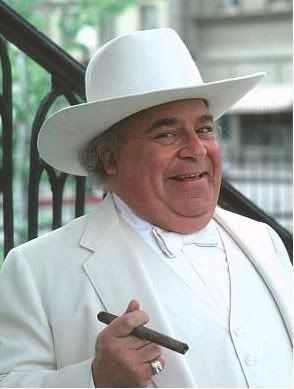
The chain was actually founded in 1979 by a 24-year-old law student called Tim Martin. The 6’6”, mullet-sporting Ulsterman took the name “Wetherspoon” from one of his teachers, while the “JD” – brilliantly – came from JD “Boss” Hogg in The Dukes Of Hazzard.
Martin supposedly modelled the chain itself on an essay by George Orwell about a fantasy pub called The Moon Under Water, which offered a quiet, drunkard-free atmosphere with friendly staff and no music. A reading of Orwell’s essay, however, demonstrates that something must have been lost in translation – he demanded beer in pewter or china mugs, open fires, liver-sausage sandwiches, strictly Victorian fittings and “motherly barmaids”.
The chain was actually founded in 1979 by a 24-year-old law student called Tim Martin. The 6’6”, mullet-sporting Ulsterman took the name “Wetherspoon” from one of his teachers, while the “JD” – brilliantly – came from JD “Boss” Hogg in The Dukes Of Hazzard.
Martin supposedly modelled the chain itself on an essay by George Orwell about a fantasy pub called The Moon Under Water, which offered a quiet, drunkard-free atmosphere with friendly staff and no music. A reading of Orwell’s essay, however, demonstrates that something must have been lost in translation – he demanded beer in pewter or china mugs, open fires, liver-sausage sandwiches, strictly Victorian fittings and “motherly barmaids”.
Monday, 28 July 2008
WRONG: Wills must be drafted by solicitors
In order to make sure your worldly goods go to the right people you do not need to write, “I, Fred Bloggs, being of sound mind and body, do hereby declare…” on a fancy piece of parchment. Technically, a scribbled note on the back of an envelope carries the same legal force as a solicitor’s document.
It is wise, however, to get a solicitor’s help anyway to prevent the will being ambiguous should someone contest it. Also, there are points of law that may change your mind about what you leave to whom. Unmarried partners, for example, are entitled to nothing at all unless it is specifically allocated in a will.
The following are the strict legal requirements for your will to be valid:
1. It must be written down, and written voluntarily.
2. You must be over 18.
3. You must be of sound mind (though there’s little point in asserting, “I am of sound mind”, because how would you know if you weren’t?)
4. It must be signed in the presence of two credible witnesses who are not themselves beneficiaries in the will. (The will will still be valid if they are, but the witnesses won't get anything.)
5. You have to sign it in the witnesses’ presence, then they have to sign it.
6. It’s worth adding the date, too, for the sake of clarity.
Even if you fulfil all the requirements, your dependents can still successfully contest the will if they feel they have been unjustly ignored. Spouses, ex-spouses (if you/they have not remarried), children, step-children or partners who depend on you financially may all claim “reasonable financial provision” under the Inheritance Act of 1975. A court will decide whether Junior has a right to your money.
Outside of those provisos, you can do what you like. In 1926, a Toronto lawyer called Charles Vance Millar decided to leave his fortune to the Toronto woman who gave birth to the greatest number of children in the ten years after his death. Four women eventually scooped $125,000 each from “The Great Stork Derby” for having nine children each. Several women had more, but, rather coldly, were disqualified because some of the children were stillborn.
In 1930, Time magazine reported the case of a Mr TM Zink of Iowa, who made an even more eccentric bequest. He left $100,000 in 1930 with the instruction that in 2005, when he expected the capital to be worth substantially more, there should be built a library in his name where women would be banned not only from using the library, but also prohibited from working as staff and even being represented as authors. He left his daughter $5 and his wife nothing at all. According to The People’s Almanac, the will was successfully contested.
Next to Mr Zink, William Shakespeare seems a positive charmer, having left to his wife “my second-best bed”.
It is wise, however, to get a solicitor’s help anyway to prevent the will being ambiguous should someone contest it. Also, there are points of law that may change your mind about what you leave to whom. Unmarried partners, for example, are entitled to nothing at all unless it is specifically allocated in a will.
The following are the strict legal requirements for your will to be valid:
1. It must be written down, and written voluntarily.
2. You must be over 18.
3. You must be of sound mind (though there’s little point in asserting, “I am of sound mind”, because how would you know if you weren’t?)
4. It must be signed in the presence of two credible witnesses who are not themselves beneficiaries in the will. (The will will still be valid if they are, but the witnesses won't get anything.)
5. You have to sign it in the witnesses’ presence, then they have to sign it.
6. It’s worth adding the date, too, for the sake of clarity.
Even if you fulfil all the requirements, your dependents can still successfully contest the will if they feel they have been unjustly ignored. Spouses, ex-spouses (if you/they have not remarried), children, step-children or partners who depend on you financially may all claim “reasonable financial provision” under the Inheritance Act of 1975. A court will decide whether Junior has a right to your money.
Outside of those provisos, you can do what you like. In 1926, a Toronto lawyer called Charles Vance Millar decided to leave his fortune to the Toronto woman who gave birth to the greatest number of children in the ten years after his death. Four women eventually scooped $125,000 each from “The Great Stork Derby” for having nine children each. Several women had more, but, rather coldly, were disqualified because some of the children were stillborn.
In 1930, Time magazine reported the case of a Mr TM Zink of Iowa, who made an even more eccentric bequest. He left $100,000 in 1930 with the instruction that in 2005, when he expected the capital to be worth substantially more, there should be built a library in his name where women would be banned not only from using the library, but also prohibited from working as staff and even being represented as authors. He left his daughter $5 and his wife nothing at all. According to The People’s Almanac, the will was successfully contested.
Next to Mr Zink, William Shakespeare seems a positive charmer, having left to his wife “my second-best bed”.
Subscribe to:
Posts (Atom)